在C语言中使用Datatype99实现类似Rust的模式匹配
引言
Datatype99是一个为C99设计的代数数据类型库,允许开发者在C语言中实现类似Rust的模式匹配功能。本文将探讨如何使用Datatype99在C语言中处理复杂的数据结构,并对比其与Rust的功能。
代数数据类型简介
代数数据类型(ADT)是一种组合多个子类型的复合类型,广泛应用于函数式编程。Rust通过`enum`关键字支持ADT,而C语言则需要借助Datatype99这样的库来模拟这一功能。
Rust中的ADT与模式匹配
enum BinaryTree {
    Leaf(i32),
    Node(Box<BinaryTree>, i32, Box<BinaryTree>),
}

fn sum(tree: &BinaryTree) -> i32 {
    match tree {
        BinaryTree::Leaf(x) => *x,
        BinaryTree::Node(lhs, x, rhs) => sum(lhs) + *x + sum(rhs),
    }
}
C语言中的Datatype99实现
以下是使用Datatype99在C语言中实现二叉树求和的例子:
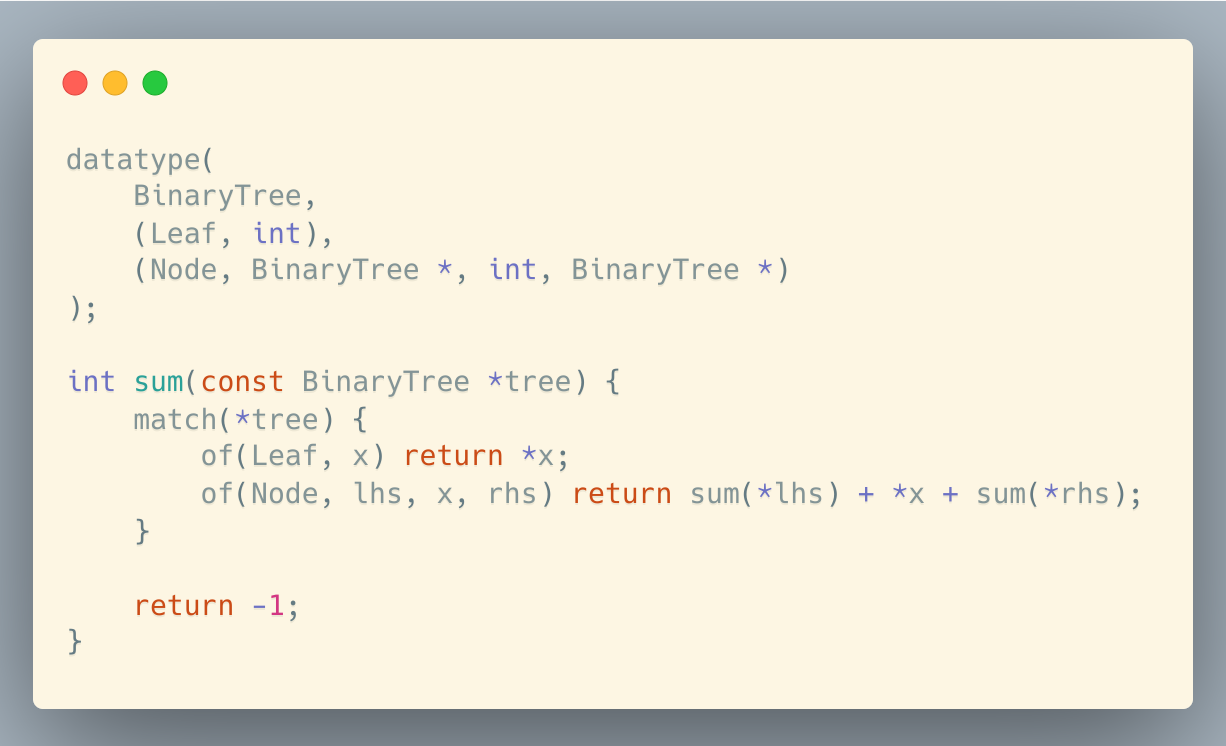
#include <datatype99.h>

datatype(
    BinaryTree,
    (Leaf, int),
    (Node, BinaryTree *, int, BinaryTree *)
);

int sum(const BinaryTree *tree) {
    match(*tree) {
        of(Leaf, x) return *x;
        of(Node, lhs, x, rhs) return sum(*lhs) + *x + sum(*rhs);
    }
    return -1; // 处理无效输入
}
Datatype99的核心语法解析
Datatype99提供了一套简洁的宏系统,让C语言能够定义和使用代数数据类型。
定义代数数据类型
#include <datatype99.h>

datatype(
    MyType,
    (Foo, int, const char *),
    (Bar, long long)
);
模式匹配
void process(MyType value) {
    match(value) {
        of(Foo, num, str) printf("Foo: %d, %s\n", *num, *str);
        of(Bar, big_num) printf("Bar: %lld\n", *big_num);
        otherwise printf("Unknown variant\n");
    }
}
构造函数
MyType x = Foo(42, "hello");  // 创建Foo变体
MyType y = Bar(123456789LL);  // 创建Bar变体
Datatype99与Rust的关键差异
- 类型安全性: Rust编译器确保模式匹配的完备性,而Datatype99依赖开发者手动检查。
- 内存管理: Rust有内置的所有权系统,而Datatype99需要手动管理内存。
- 语法简洁性: Rust语法更简洁直观,而Datatype99通过宏系统实现类似功能。
实用示例:二叉树操作
// 创建树节点的辅助宏
#define TREE(tree) ((BinaryTree *)(BinaryTree[]){tree})
#define NODE(left, number, right) TREE(Node(left, number, right))
#define LEAF(number) TREE(Leaf(number))

int main(void) {
    const BinaryTree *tree = NODE(NODE(LEAF(1), 2, NODE(LEAF(3), 4, LEAF(5))), 6, LEAF(7));

    printf("%d\n", sum(tree)); // 输出: 28
    return 0;
}
如何开始使用Datatype99
- 克隆仓库:
git clone https://gitcode.com/gh_mirrors/da/datatype99 - 包含头文件:
#include <datatype99.h> - 查看examples/目录下的示例代码,快速掌握使用方法。
